


Estimated Reading Time: 10 minutes
This article is brought to you by Sarthi Institute of Law to help law students and judiciary aspirants understand the difference between Mitakshara and Dayabhaga schools of Hindu law, including coparcenary rules and judicial developments.
Introduction
The topic of Mitakshara vs Dayabhaga is one of the most important and frequently searched concepts under schools of Hindu law, especially for law students and judiciary aspirants. Understanding the difference between Mitakshara and Dayabhaga, particularly in relation to coparcenary and inheritance, is essential for mastering Hindu law.
In simple terms, Mitakshara and Dayabhaga represent two distinct legal schools governing the devolution of property, coparcenary rights, and succession in a Hindu Joint Family. While Mitakshara is followed across most of India, Dayabhaga is primarily applicable in West Bengal and Assam.
The distinction between these two schools becomes crucial when analyzing rights by birth, ownership structure, and inheritance rules, making it a core topic for both academic study and competitive examinations.
Meaning of Mitakshara and Dayabhaga Schools of Hindu Law
The Mitakshara school of Hindu law is based on a commentary written by Vijnaneshwara on the Yajnavalkya Smriti. It is the most widely followed school in India and is characterized by the principle that coparcenary rights arise by birth.
On the other hand, the Dayabhaga school of Hindu law, based on the work of Jimutavahana, follows a different approach. Under Dayabhaga, ownership in property arises only after the death of the father, and there is no concept of coparcenary by birth in the traditional sense.
Thus, the primary distinction between Mitakshara and Dayabhaga lies in the timing and nature of property rights.
Legal Framework and Relevance of Mitakshara vs Dayabhaga
Both Mitakshara and Dayabhaga form part of classical Hindu law, but their application has been significantly influenced by statutory developments such as the Hindu Succession Act, 1956 and its 2005 amendment.
While the Act has largely unified succession laws, the conceptual differences between these schools still remain relevant, particularly in understanding coparcenary structure, inheritance principles, and judicial interpretation.
For judiciary aspirants, questions frequently test the difference between Mitakshara and Dayabhaga, making it a high-priority topic.
Difference between Mitakshara and Dayabhaga under Hindu Law
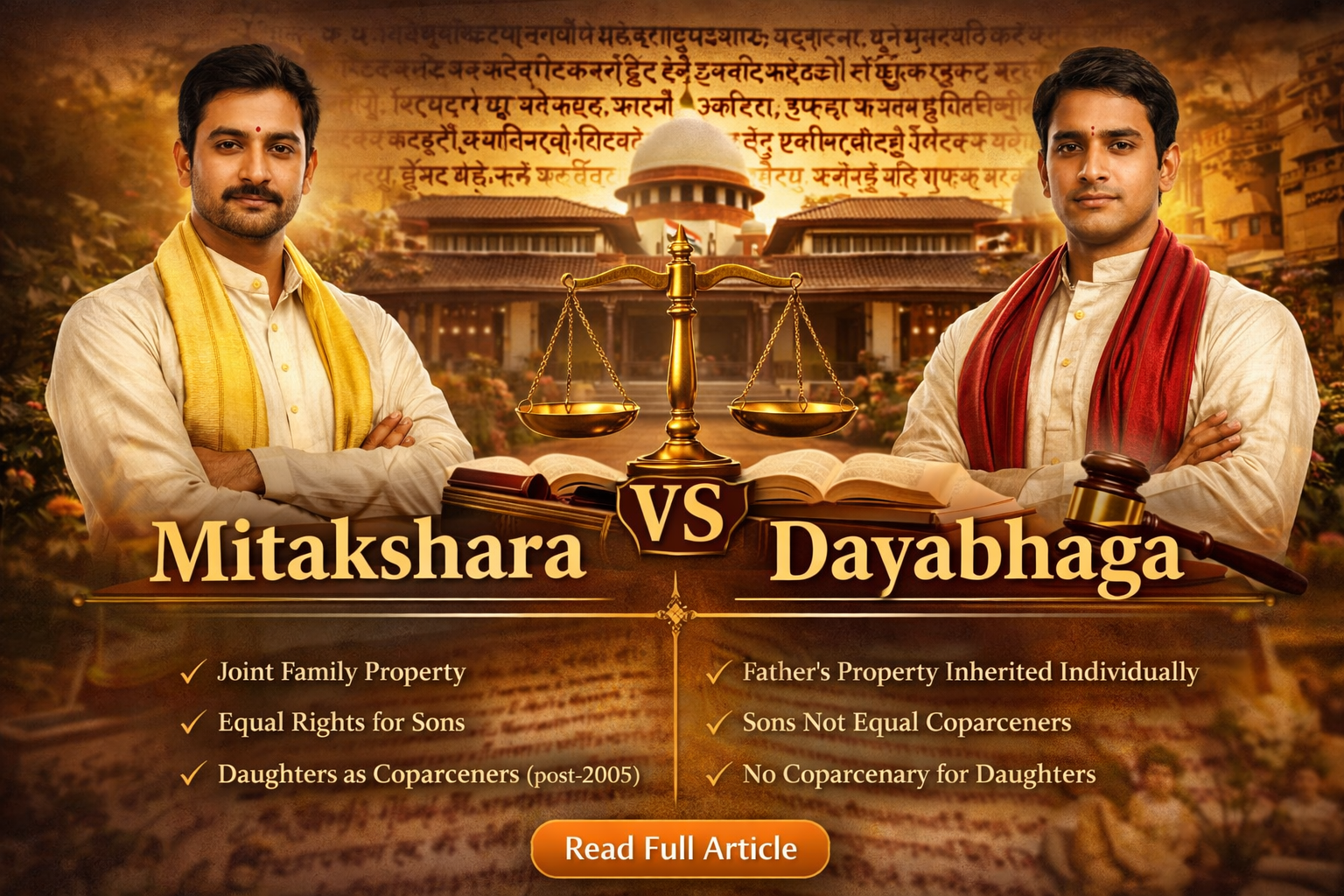
The difference between Mitakshara and Dayabhaga is most clearly understood through their approach to coparcenary and property rights.
Under Mitakshara law, a son acquires a right in ancestral property by birth, which creates a coparcenary consisting of male members (and now daughters after the 2005 amendment). This leads to a system of joint ownership and unity of possession, where no individual coparcener has a definite share until partition.
In contrast, under Dayabhaga law, no such right arises by birth. The father retains absolute ownership over the property during his lifetime, and inheritance occurs only after his death. As a result, there is no coparcenary in the traditional Mitakshara sense during the father’s lifetime.
Another important distinction lies in the concept of partition. Under Mitakshara, a coparcener can demand partition at any time, whereas under Dayabhaga, such a right arises only after succession opens.
Coparcenary Difference between Mitakshara and Dayabhaga
The coparcenary difference between Mitakshara and Dayabhaga is one of the most critical aspects of this topic.
In Mitakshara law, coparcenary is a fundamental concept, where members acquire an interest in property by birth. This creates a collective ownership structure, and each coparcener has a fluctuating share depending on the number of members in the family.
In Dayabhaga law, however, coparcenary does not exist in the same form. Since ownership is not acquired by birth, the father remains the absolute owner of the property, and heirs receive their share only after his death. This results in a more individualized system of ownership, as opposed to the joint ownership seen in Mitakshara.
| Basis of Difference | Mitakshara School | Dayabhaga School |
|---|---|---|
| Origin | Based on the commentary of Vijnaneshwara on Yajnavalkya Smriti | Based on the treatise of Jimutavahana |
| Geographical Application | Followed across most of India | Mainly followed in West Bengal and Assam |
| Right to Property | Right arises by birth | Right arises after the death of the father |
| Coparcenary | Coparcenary exists from birth | No coparcenary during father’s lifetime |
| Ownership of Property | Joint ownership among coparceners | Absolute ownership of father during lifetime |
| Nature of Interest | Fluctuating interest (changes with births and deaths) | Fixed share after succession opens |
| Right to Demand Partition | Can be demanded at any time by coparcener | Arises only after death of father |
| Alienation of Property | Limited power; consent or necessity required | Father has wider power of disposition |
| Position of Father | Father is Karta but not absolute owner | Father is absolute owner of property |
| Inheritance Principle | Based on survivorship (traditional rule) | Based on succession/inheritance |
| Female Rights (Post-2005) | Daughters are coparceners by birth | Inheritance rights exist, but no coparcenary concept |
| Doctrine of Pious Obligation | Recognized | Not recognized |
| Unity of Possession | Exists (joint possession) | Does not exist in same manner |
Important Supreme Court Judgments on Mitakshara Coparcenary
Judicial interpretation has played a crucial role in shaping the understanding of Mitakshara coparcenary and its evolution.
🔹 Vineeta Sharma v. Rakesh Sharma
In this landmark judgment, the Supreme Court clarified that a daughter becomes a coparcener by birth under the Mitakshara system, irrespective of whether the father was alive on the date of the 2005 amendment. The Court resolved conflicting decisions and held that the right is unobstructed heritage, meaning it accrues by birth and is not dependent on the father’s existence.
The Court emphasized that denying such rights would violate the constitutional principle of equality. The ratio decidendi of the case lies in recognizing that the amendment was intended to remove gender discrimination and ensure equal property rights.
🔹 Commissioner of Wealth Tax v. Chander Sen
In this case, the Supreme Court examined whether property inherited by a son from his father should be treated as ancestral property or self-acquired property. The Court held that after the enactment of the Hindu Succession Act, 1956, such property should be treated as individual property, unless it retains the characteristics of joint family property.
The judgment clarified the impact of statutory law on traditional Mitakshara principles and limited the automatic expansion of coparcenary property.
Relevance of Mitakshara vs Dayabhaga for Judiciary Exams
For judiciary aspirants, the topic of Mitakshara vs Dayabhaga is highly significant due to its conceptual clarity and frequent appearance in examinations.
Students are often required to explain the difference between Mitakshara and Dayabhaga, particularly focusing on:
- Coparcenary rights
- Ownership structure
- Succession rules
- Impact of the 2005 amendment
A clear understanding of these distinctions not only helps in answering theoretical questions but also in solving problem-based questions in exams.
Conclusion
The comparison of Mitakshara vs Dayabhaga highlights two distinct approaches to property rights and inheritance under Hindu law. While Mitakshara emphasizes birth-based rights and joint ownership, Dayabhaga focuses on succession-based ownership and individual rights.
Over time, statutory reforms and judicial decisions have modernized these concepts, particularly by recognizing equal rights for daughters in coparcenary property. However, the fundamental differences between these schools continue to hold academic and practical significance.
For law students and judiciary aspirants, mastering this topic is essential for developing a deeper understanding of Hindu law and its evolution.
Frequently Asked Questions (FAQs)
1. What is the difference between Mitakshara and Dayabhaga?
The key difference between Mitakshara and Dayabhaga lies in property rights. Under Mitakshara, rights arise by birth, whereas under Dayabhaga, rights arise after the death of the father.
2. What is coparcenary under Mitakshara law?
Coparcenary under Mitakshara law refers to a group of family members who acquire an interest in ancestral property by birth.
3. Does coparcenary exist in Dayabhaga law?
No, the concept of coparcenary in the Mitakshara sense does not exist in Dayabhaga law, as ownership arises only after succession.
4. Can daughters be coparceners under Mitakshara law?
Yes, after the 2005 amendment and the judgment in Vineeta Sharma v. Rakesh Sharma, daughters are coparceners by birth.
References
- Vineeta Sharma v. Rakesh Sharma, (2020) 9 SCC 1.
- Comm’r of Wealth Tax v. Chander Sen, (1986) 3 SCC 567.
- Mulla, Principles of Hindu Law (22nd ed.).
- Mayne, Hindu Law and Usage (16th ed.).